> For the complete documentation index, see [llms.txt](https://docs.symm.io/llms.txt). Markdown versions of documentation pages are available by appending `.md` to page URLs; this page is available as [Markdown](https://docs.symm.io/liquidity-provider-documentation/building-a-solver-on-symmio/2.-seeing-the-intent.md).
# 2. Seeing the Intent
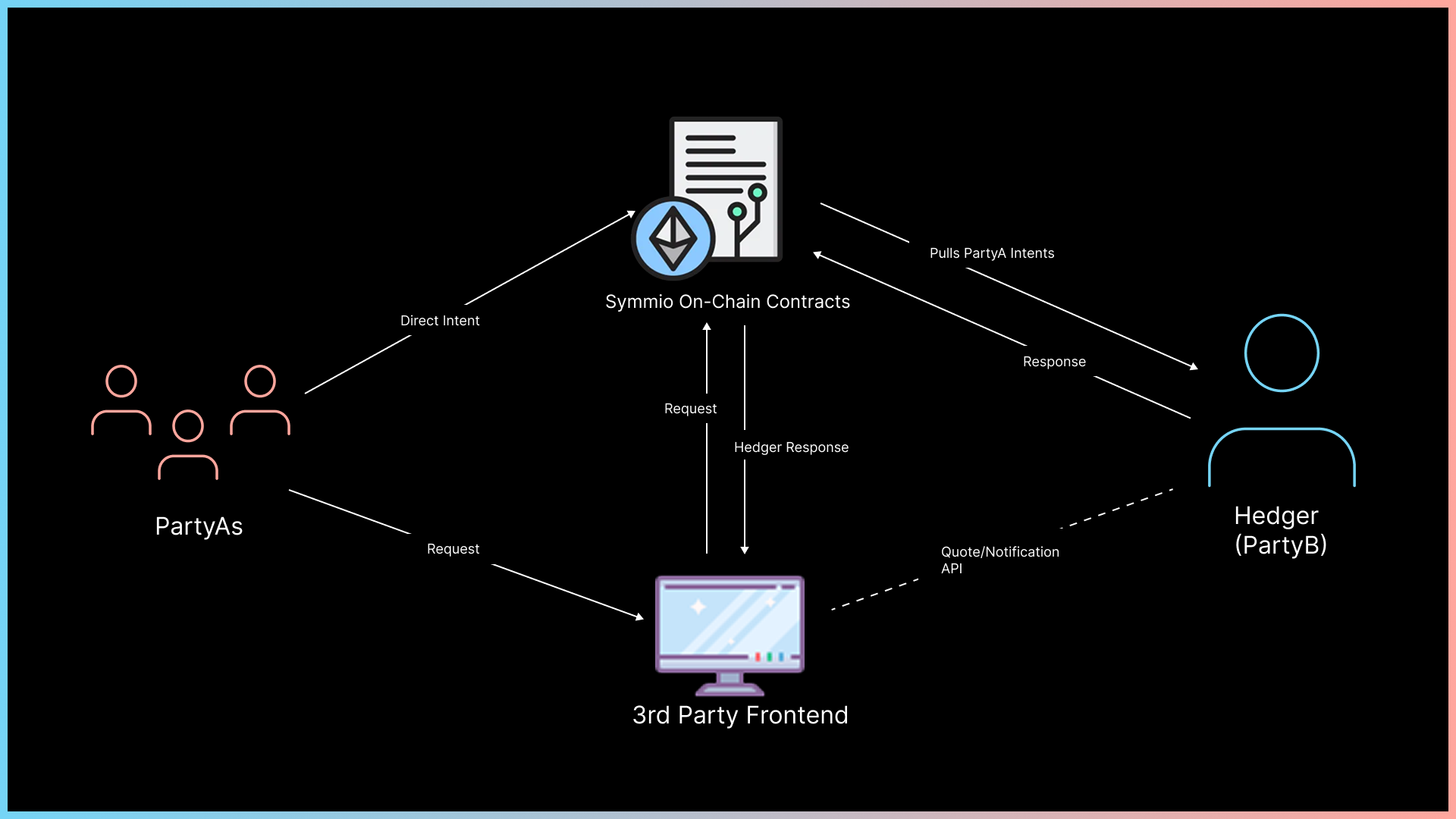
To build a reliable hedging service in the Symmio ecosystem, hedgers (PartyB) need to monitor the blockchain events triggered by PartyA's intents. This section shows a basic event-listener implementation using `ethers.js` or `web3.py`.
### Web3EventPoller
The `Web3EventPoller` class is a high-level utility that:
1. **Connects to the blockchain** using `web3.py`.
2. **Loads the contract and ABI** to interact with its events.
3. **Monitors events** such as `SendQuote` or `ForceCancelQuote`.
4. **Handles events** by delegating to predefined handler classes (e.g. `SendQuoteHandler`).
5. **Maintains state** with an `EventPoller` instance that manages polling, handles retries, and ensures no events are missed.
```python
from web3 import Web3
from web3.middleware import geth_poa_middleware
import logging
from settings import RPC, ContractAddress, PollInterval, FromBlock
from event_poller import EventPoller
from handlers.send_request_handler import SendQuoteHandler
class Web3EventPoller:
@staticmethod
def run():
# 1. Initialize Web3 and contract
w3_instance = Web3(Web3.HTTPProvider(RPC))
w3_instance.middleware_onion.inject(geth_poa_middleware, layer=0)
contract_abi = [...] # Loaded from a JSON file
contract = w3_instance.eth.contract(address=ContractAddress, abi=contract_abi)
# 2. Create a poller instance
poller = EventPoller(
context=...,
from_block=FromBlock,
poll_interval=PollInterval
)
# 3. Register event + handler
poller.add_event("SendQuote", SendQuoteHandler().handle)
# ... add other events as needed ...
# 4. Start the poller
poller.start()
poller.wait()
```
### Event Poller Internals
`EventPoller`: A utility script that tracks from\_block progress (often persisted in something like Redis) and polls in intervals (poll\_interval).
```python
class EventPoller:
def __init__(self, context, from_block=0, poll_interval=10, block_chunk_size=10000):
# 1. Initialize context, default block, and interval settings.
# 2. Create data structures to track events and their states.
# 3. Set up a thread pool executor for concurrent event polling.
self.context = context
self.tracked_events = {}
self.poll_interval = poll_interval
self.block_chunk_size = block_chunk_size
self.stop_signal = False
self.default_from_block = from_block
self.futures = {}
self.event_from_blocks = {}
self.executor = ThreadPoolExecutor()
def add_event(self, event_name, callback=None):
# 1. Register the event name and callback in `tracked_events`.
# 2. Check Redis for the last processed block for the event.
# 3. Set `from_block` for the event based on Redis or the default value.
self.tracked_events[event_name] = callback
stored_from_block = REDIS_SERVER.get("event_poller_from_block_" + event_name)
self.event_from_blocks[event_name] = int(
stored_from_block) if stored_from_block is not None else self.default_from_block
def remove_event(self, event_name):
# 1. Remove the event and its block tracking state.
# 2. Stop the associated polling thread if it's running.
if event_name in self.tracked_events:
del self.tracked_events[event_name]
del self.event_from_blocks[event_name]
self.stop_event_thread(event_name)
def _fetch_event(self, event_name, callback, from_block, to_block):
# 1. Retrieve the event object from the contract.
# 2. Create a filter for logs between `from_block` and `to_block`.
# 3. Fetch all logs and update the last processed block in Redis.
# 4. Invoke the callback for each log if provided.
event = getattr(self.context.contract.events, event_name)
event_filter = event.create_filter(fromBlock=from_block, toBlock=to_block)
events = event_filter.get_all_entries()
REDIS_SERVER.set_permanent("event_poller_from_block_" + event_name, to_block)
self.event_from_blocks[event_name] = int(to_block) + 1
if callback:
for ev in events:
callback(self.context, ev)
return events
def _run_event(self, event_name, callback):
# 1. Poll the blockchain to get the current block number.
# 2. Fetch logs for the event in chunks until the current block.
# 3. Invoke the callback for each log and sleep for `poll_interval`.
while not self.stop_signal:
current_block = self.context.provider.eth.block_number
from_block = self.event_from_blocks[event_name]
while from_block < current_block:
end_block = min(from_block + self.block_chunk_size - 1, current_block)
self._fetch_event(event_name, callback, from_block, end_block)
from_block = end_block + 1
time.sleep(self.poll_interval)
def start(self):
# 1. Spawn a thread for each registered event using the executor.
# 2. Each thread invokes `_run_event` to monitor and process logs.
for event_name, callback in self.tracked_events.items():
future = self.executor.submit(self._run_event, event_name, callback)
self.futures[event_name] = future
def wait(self):
# 1. Block until all threads complete their tasks.
# 2. Ensures the application does not exit prematurely.
for future in self.futures.values():
future.result()
def stop(self):
# 1. Set `stop_signal` to True to gracefully terminate polling.
# 2. Used to shut down the poller when the application exits.
self.stop_signal = True
def stop_event_thread(self, event_name):
# 1. Cancel the thread associated with the specified event.
# 2. Remove the thread from the `futures` dictionary.
if event_name in self.futures:
self.futures[event_name].cancel()
del self.futures[event_name]
```
### Send Quote Handler
The `SendQuoteHandler` processes `SendQuote` events from PartyA. It should validate the event data (e.g., whitelist checks, quote status) and construct and stores a structured payload in Redis for further use by the system.
```python
import datetime
import logging
import simplejson as json
from settings import HedgerAddress
from share import REDIS_SERVER_EVENTS
class SendQuoteHandler:
def handle(self, context, args):
# 1. Extract event data and block information
event_values = args.get('args')
block = context.provider.eth.get_block(args.get("blockNumber"))
# 2. Fetch additional data for the symbol and quote
symbol = context.symbol_fm.map_fields(
context.view_provider.contract.functions.getSymbol(event_values.get("symbolId")).call()
)
quote = context.quote_fm.map_fields(
context.view_provider.contract.functions.getQuote(event_values.get("quoteId")).call()
)
# 3. Check if the quote has already been processed
quote_status = quote.get("quoteStatus")
if quote_status == 3:
return
# 4. Validate if the hedger is in the whitelist for this quote
whitelist = [context.provider.to_checksum_address(addr) for addr in event_values.get("partyBsWhiteList")]
if len(whitelist) > 0 and HedgerAddress not in whitelist:
return
# 5. Construct a payload with relevant event and blockchain data
value = {
"blockNumber": args.get("blockNumber"),
"cva": event_values.get("cva"),
"lf": event_values.get("lf"),
"partyAmm": event_values.get("partyAmm"),
"partyBmm": event_values.get("partyBmm"),
"quantity": event_values.get("quantity"),
"marketPrice": event_values.get("marketPrice"),
"requestedOpenPrice": event_values.get("price"),
"quoteStatus": quote.get("quoteStatus"),
"quoteId": event_values.get("quoteId"),
"symbolId": event_values.get("symbolId"),
"symbol": symbol.get("name"),
"action": "SendQuote",
"partyA": context.provider.to_checksum_address(event_values.get("partyA")),
"positionType": event_values.get("positionType"),
"orderTypeOpen": event_values.get("orderType"),
"maxFundingRate": event_values.get("maxFundingRate"),
"deadline": event_values.get("deadline"),
"timeStamp": block.get("timestamp"),
"timestampsSendQuoteTimeStamp": block.get("timestamp"),
"trHash": args.get("transactionHash").hex(),
"received_timestamp": datetime.datetime.utcnow().timestamp() // 1000,
"input_source": 'py_event_listener',
"type": 'quote'
}
# 6. Generate a unique key for the Redis store
key = f"{event_values.get('quoteId')}-{args.get('transactionHash').hex()}-{block.get('timestamp')}"
# 7. Log the event for debugging purposes
logging.info("SendQuote Received: " + key)
# 8. Store the event data in Redis if the key does not already exist
REDIS_SERVER_EVENTS.setnx(key, json.dumps(value))
```
**Extract Event Data and Block Information**
```python
event_values = args.get('args')
block = context.provider.eth.get_block(args.get("blockNumber"))
```
* Retrieves the event arguments (`args`) and the blockchain block details (`block`).
**Fetch Additional Data for the Symbol and Quote**
```python
symbol = context.symbol_fm.map_fields(
context.view_provider.contract.functions.getSymbol(event_values.get("symbolId")).call()
)
quote = context.quote_fm.map_fields(
context.view_provider.contract.functions.getQuote(event_values.get("quoteId")).call()
)
```
* Fetches detailed information about the symbol and quote using their IDs.
* Maps the raw blockchain data into structured fields for easier access.
**Check If the Quote Is Already Processed**
```python
quote_status = quote.get("quoteStatus")
if quote_status == 3:
return
```
Checks the status of the quote. If it has already been processed (status 3), the handler exits early.
**Validate PartyB Whitelist**
```python
whitelist = [context.provider.to_checksum_address(addr) for addr in event_values.get("partyBsWhiteList")]
if len(whitelist) > 0 and HedgerAddress not in whitelist:
return
```
Confirms that the current hedger (PartyB) is authorized to act on this quote. If a whitelist exists and the hedger is not included, the handler skips processing.
**Constructing the Payload**
```python
value = {
"blockNumber": args.get("blockNumber"),
...
"type": 'quote'
}
```
Creates a structured dictionary containing all relevant event and blockchain data. This includes trade details (e.g., `quoteId`, `price`), contextual metadata (e.g., `blockNumber`), and hedger-specific information (e.g., `partyBmm`).
**Generate a Unique Key for Redis**
```python
key = f"{event_values.get('quoteId')}-{args.get('transactionHash').hex()}-{block.get('timestamp')}"
```
Ensures that each event is uniquely identified to avoid duplication in the Redis store.
**Logging the Event**
```python
logging.info("SendQuote Received: " + key)
```
Logs the event processing for debugging and traceability.
**Store the Event Data in Redis**
```python
REDIS_SERVER_EVENTS.setnx(key, json.dumps(value))
```
Stores the payload in Redis using the unique key. The `setnx` method ensures that the event is only stored if the key does not already exist.
---
# Agent Instructions
This documentation is published with GitBook. GitBook is the documentation platform designed so that both humans and AI agents can read, navigate, and reason over technical content effectively. Learn more at gitbook.com.
## Querying This Documentation
If you need additional information that is not directly available in this page, you can query the documentation by asking a question.
Perform an HTTP GET request on the following URL with the `ask` and `goal` query parameters:
```
GET https://docs.symm.io/liquidity-provider-documentation/building-a-solver-on-symmio/2.-seeing-the-intent.md?ask=&goal=
```
`ask` is the immediate question: it should be specific, self-contained, and written in natural language.
`goal` is what the user is ultimately trying to achieve, the reason they need the answer. Sharing it helps GitBook give you a better, more relevant answer. A goal is most helpful when it describes the outcome the user wants rather than restating the question. For example, with `ask=how do I create an API token`, a goal like `automate deployments from our CI pipeline` lets GitBook tailor the answer to that use case.
The response will contain a direct answer to the question and relevant excerpts and sources from the documentation.
Use this mechanism when the answer is not explicitly present in the current page, you need clarification or additional context, or you want to retrieve related documentation sections.